Match the Sound to the Cause
| Sound | Likely cause | Typical fix |
|---|
| Rumbling or popping | Sediment layer boiling on the tank bottom | Flush the tank; assess age if noise returns fast |
| Ticking or tapping | Pipe expansion, or sediment in a heat trap nipple | Often harmless; check straps and fittings if new |
| Humming (electric models) | A loose or failing heating element vibrating | Test and tighten or replace the element |
| Screeching or whistling | Water forced through a partly closed valve or scaled fitting | Check inlet and outlet valves and fittings |
| Sizzling | Condensation or a small leak dripping onto a hot surface | Inspect fittings and the tank for active leaks right away |
Why Sediment Builds Up Here
Rutherford County water is moderately hard, and every gallon heated in a tank leaves a little mineral behind. In a home that has never flushed its water heater, five to ten years of that buildup forms a real layer. Our guide to hard water in La Vergne explains the local water picture, and it is why annual flushing matters more here than in soft-water cities. Tankless units are not exempt either: scale coats their heat exchangers and they need periodic descaling, covered on our tankless water heater page.
Flushing Helps, Until It Does Not
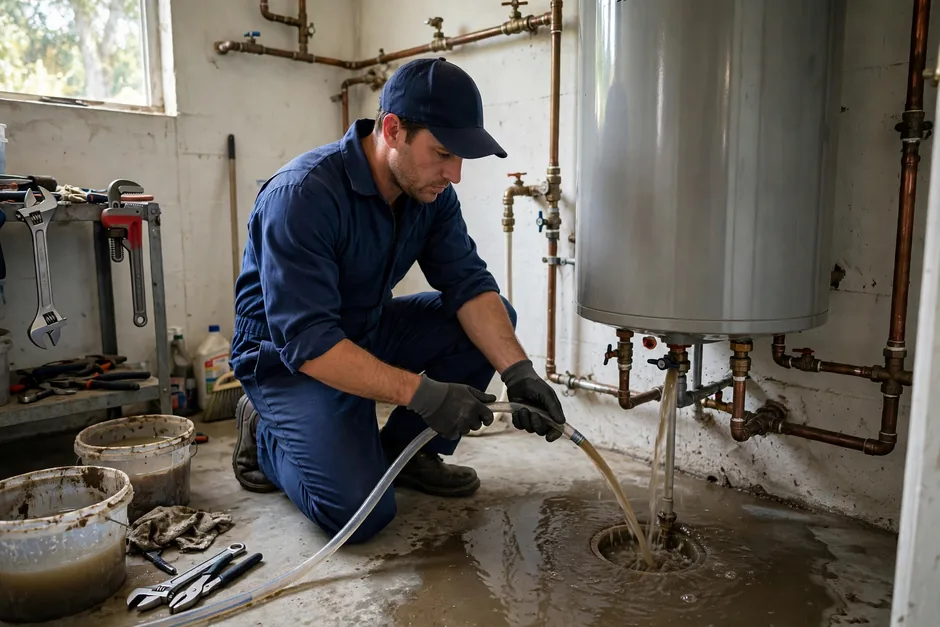
On a younger tank, a full flush usually removes the loose sediment and the noise stops. Two cautions matter. First, if the tank has never been flushed and the drain valve is corroded, forcing the issue can start a leak at the valve. Second, on a tank past roughly ten years, heavy sediment often means the bottom has been overheating for a long time, and quieting it does not restore the lost life. That is the repair or replace judgment in our water heater decision guide. Homes in Heritage Valley with original-era heaters and cottages in Cottages of Lake Forest with compact tank closets hit this call often.
One safety line: sizzling, visible leaking, or a rotten-egg smell near a gas heater is not a wait-and-see problem. Shut the unit down and call.